Canadian Housing Rebound, Auto Tariffs, & Private Credit Surge Impact Market
Pre-Market Daily Brief: January 17, 2026
Good morning, active traders. As we gear up for today's session, global markets appear cautiously optimistic amid stabilizing economic indicators in North America, though cross-border trade tensions continue to inject volatility. Overnight, Asian indices closed mixed, with the Nikkei up 0.3% on tech resilience and the Hang Seng dipping 0.2% due to property sector jitters. U.S. futures are pointing to a flat open, while Canadian markets show mild gains in pre-market trading, buoyed by positive real estate forecasts and domestic investment flows. Key drivers today include evolving U.S.-Canada trade dynamics in the auto sector and renewed institutional commitments to private markets, which could influence broader risk appetite. Let's dive into the most market-impacting developments from an investor's lens, enriched with the latest data.
Overnight & Pre-Market Snapshot
- Asia: Nikkei +0.3% (tech resilience); Hang Seng -0.2% (property jitters).
- U.S.: Futures point to a flat open.
- Canada: Mild pre-market gains on positive real estate forecasts and domestic investment flows.
- Key drivers: U.S.-Canada auto trade dynamics; renewed institutional commitments to private markets.
Canadian Housing Market Poised for Rebound: CREA's Upbeat 2026-2027 Forecast Signals Opportunity in Real Estate Plays
The Canadian Real Estate Association (CREA) has revised its outlook for the resale housing market, projecting a robust recovery in 2026 that could spill over into mortgage finance, construction, and REIT sectors. According to CREA's January 15 update, national home sales are now expected to rise 8.5% in 2026 to 530,000 units—up from a prior forecast of 6% growth—before easing to 4.2% in 2027. Average home prices are forecasted to climb 4.8% this year to $720,000, accelerating to 5.1% in 2027 amid stabilizing interest rates and anticipated tariff resolutions.
This shift comes after a sluggish 2025, where national sales fell nearly 2% to 488,700 units, the lowest since 1996, hampered by high borrowing costs and affordability woes. CREA attributes the improved outlook to the Bank of Canada's steady policy stance—holding rates at 3.75%—and potential clarity on U.S. tariffs, which could ease inflationary pressures on building materials and boost cross-border economic activity. Regionally, hot spots like British Columbia and Ontario are seen driving the surge, with sales up 12% and 10% respectively in 2026.
For traders, this is bullish for Canadian banks (e.g., RY, TD) and homebuilders (e.g., CAR.UN), as increased transactions could lift loan volumes and related fees. Watch for volatility in materials like lumber (e.g., via WFG on TSX), where tariff relief might compress margins short-term but expand demand longer-term. Overall sentiment here leans positive, potentially adding tailwinds to the TSX's real estate index, which is up 1.2% YTD. If U.S. consumer confidence data later today aligns with this optimism, it could catalyze a broader North American housing rally.
U.S. Auto Market Share in Canada Plunges to Record Low Amid Tariff Escalation: Trade War Risks Weigh on Automakers
Trade frictions are escalating, with U.S.-built vehicles' market share in Canada hitting a historic low of 28% in 2025—down from 40% a decade ago—as retaliatory tariffs disrupt integrated supply chains. Bloomberg reports that the slump accelerated in Q4 2025, with U.S. imports falling 15% YoY while Japanese and Korean brands gained ground, capturing 45% combined. Canada's 100% tariffs on Chinese EVs, implemented last fall, have indirectly amplified the pain by redirecting global flows and inflating costs for North American producers reliant on shared components.
The turmoil stems from ongoing U.S. demands for stricter rules-of-origin under the USMCA, prompting Ottawa to impose counter-tariffs on select U.S. auto parts. This has forced Canadian dealers to pivot, boosting imports from non-U.S. sources like Mexico (now at 22% share) and Europe. GM and Ford, major U.S. exporters to Canada, saw their combined sales drop 18% last year, per AutoCanada data.
High-conviction shorts or hedges on U.S. automakers (e.g., GM, F) make sense here, with shares already down 5-7% in the past month on tariff fears. Canadian plays like Magna International (MG.TO) could benefit from diversified sourcing but face near-term margin squeezes. Broader market ripple: This drags on industrial ETFs (e.g., XLI), and any escalation ahead of USMCA reviews could spike the USD/CAD pair toward 1.42. Sentiment is bearish for the sector, underscoring why tariff-sensitive names are underperforming the S&P 500 by 4% YTD.
BlackRock Doubles Down on Private Credit: Unfazed by Default Risks, Eyes $400B Fundraising Milestone
BlackRock's aggressive push into private credit remains a standout amid rising corporate default concerns, with the firm signaling confidence in its $14 trillion AUM powerhouse. Following the 2023 acquisition of HPS Investment Partners for $1.2 billion—which supercharged its alternatives arm to $350 billion—BlackRock is targeting $400 billion in private markets fundraising by 2030, per recent disclosures. Executives, including CEO Larry Fink, dismissed default upticks (projected at 4-5% for 2026 by Moody's) as "manageable," citing diversified portfolios heavy on middle-market loans to resilient sectors like tech and healthcare.
HPS's latest fund, a $10 billion private credit vehicle, is drawing institutional and high-net-worth inflows at a 20% clip above targets, even as public high-yield spreads widen to 450 bps. BlackRock's integration of Aladdin tech for risk analytics has enabled double-digit growth in alternatives, outpacing peers like Blackstone.
This bolsters conviction in asset managers (e.g., BLK up 2% pre-market), as private credit's 8-10% yields attract yield-hungry investors fleeing volatile equities. For traders, watch BLK options for upside momentum if AUM reports top estimates next week. Globally, it signals melting risk aversion, potentially lifting credit ETFs (e.g., LQD) if defaults stay contained. Sentiment: Strongly positive, reinforcing private markets as a hedge against public equity wobbles.
CPP Investments Bolsters Canadian Private Equity: $750M Infusion Signals Domestic Confidence
Canada Pension Plan Investment Board (CPP Investments) is deepening its roots at home, committing $750 million to refresh its mid-market private equity partnership with Northleaf Capital Partners. This expansion, announced January 15, targets scalable domestic opportunities in infrastructure and growth equity, building on a decade-long collaboration that has deployed over $2 billion.
With CPP's total AUM at $650 billion, this move underscores a strategic pivot toward Canadian assets amid global uncertainties, focusing on sectors like renewables and tech. Northleaf, managing $12 billion, plans to deploy the capital into 20-25 deals over three years, emphasizing ESG-aligned firms.
Positive for Canadian venture and PE exposure (e.g., via RY's wealth management arms). It could catalyze M&A activity in TSX mid-caps, lifting sentiment in the S&P/TSX Composite. As a barometer of institutional flows, this counters trade headwinds and supports CAD stability.
Wrapping Up
Today's narrative blends recovery optimism in housing and alternatives with auto-sector caution—net neutral to mildly positive for North American indices. Key levels to watch: S&P 500 resistance at 5,850; TSX support at 24,200. Stay nimble on tariff headlines, and trade smart. Until next brief—happy trading.
This brief is for informational purposes only and not investment advice. Data sourced from CREA, Bloomberg, Business Insider, and CPP Investments as of January 16, 2026.
Gain Your Edge: The Tools That Power Pro-Level Analysis
In the market, the right tools separate the professionals from the crowd. We've identified the game-changing platforms that deliver institutional-grade data, faster execution, and deeper insights. Elevate your strategy from guesswork to a high-performance system with the same resources used by top market analysts.
The Charting Platform We Use Every Day
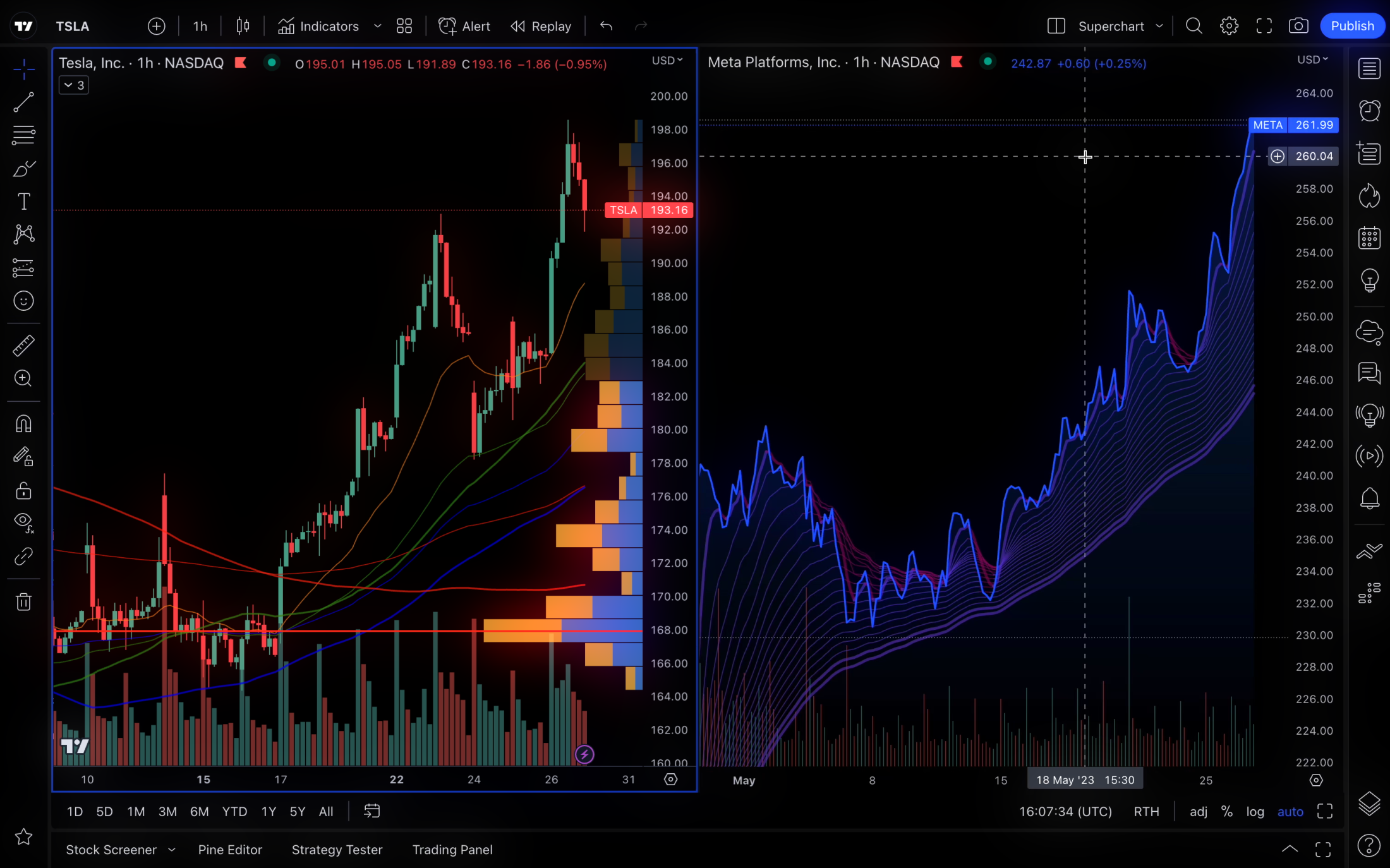
Effective market analysis requires professional-grade tools. TradingView offers best-in-class live charts, hundreds of pre-built indicators, and advanced drawing tools for stocks, crypto, and forex. It's the essential platform our analysts rely on to identify trends and track market shifts.